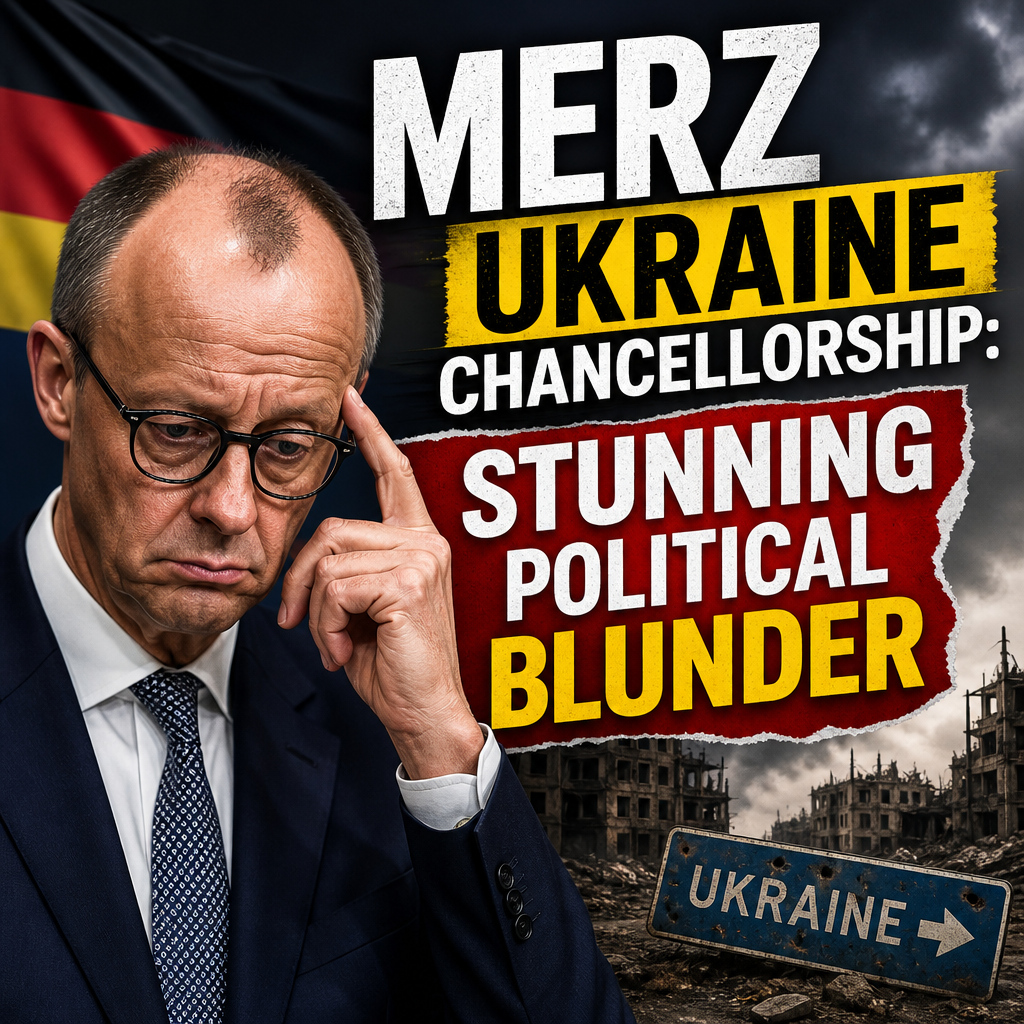
Merz Ukraine Chancellorship: Stunning Political Blunder


Merz Ukraine Chancellorship is being framed by critics as a political misstep, but the reality is more complicated than a single headline suggests. Friedrich Merz has spent much of his rise to Germany’s top job trying to project firmness, Atlanticism, and a clear break with hesitation on security policy. Yet his comments and positioning on Ukraine have opened him up to a familiar danger in modern European politics: saying enough to look decisive, but not enough to avoid backlash from voters who want either more caution or more resolve.
Merz Ukraine Chancellorship and the politics of taking sides
At the center of the controversy is a basic tension in German politics. Germany remains one of Ukraine’s key European supporters, but public patience with the war has thinned, economic pressure is still visible, and coalition politics in Berlin make bold foreign-policy signals risky. Merz’s supporters argue that a chancellor must speak plainly about Russian aggression and Germany’s responsibilities. His critics, however, see a leader who may be overplaying moral certainty at the expense of domestic consensus.



That divide matters because Ukraine policy in Germany is no longer just about foreign affairs. It has become a test of leadership style. A politician can sound principled in Brussels or Kyiv and still lose ground at home if voters believe the costs are being underestimated. That is where the “stunning political blunder” narrative gains traction: it suggests not simply a mistake in messaging, but a failure to read the mood of the electorate.
At the same time, it is worth separating political symbolism from policy substance. Merz’s hard line may appeal to voters who want Germany to remain a dependable European power. For them, caution can look like weakness, especially after years of hesitation over weapons deliveries and military support. Seen through that lens, Merz is not blundering so much as making a calculated bet that seriousness on Ukraine will prove popular in the long run.




What different newsrooms are emphasizing
The story looks very different depending on the source.
– RT’s framing leans strongly toward the idea that Merz has made a major error, portraying his Ukraine stance as a destabilizing political choice and highlighting the costs of confrontation with Russia.
– Sky News coverage of European politics tends to place Merz’s decisions in the context of coalition constraints, German public opinion, and the pressure on leaders to balance security commitments with domestic concerns.
– Al Jazeera often situates the war in a broader geopolitical and humanitarian frame, emphasizing the consequences for civilians, the limits of Western unity, and the strain the conflict places on governments across Europe.
Taken together, these viewpoints reveal why the debate is so polarized. RT’s angle stresses strategic overreach and political misjudgment. Sky News is more likely to ask whether the stance is sustainable domestically. Al Jazeera usually broadens the lens, reminding readers that every European calculation is being made against a war that is still producing casualties, displacement, and economic disruption.
The result is less a clean verdict than a clash of narratives. If you begin with the assumption that Germany should prioritize de-escalation and economic stability, Merz looks reckless. If you start from the belief that Europe must deter aggression and support Ukraine decisively, his approach can seem overdue rather than mistaken.
The real risk: looking certain when voters want nuance
Merz’s challenge is that Ukraine policy rewards confidence but punishes simplification. He needs to reassure allies that Germany will not waver, while also convincing skeptical Germans that solidarity with Kyiv does not mean blank-check escalation or open-ended costs. That balance is hard to strike, and it is where many leaders stumble.
A few factors make this particularly delicate:
– War fatigue: Many voters are tired of a conflict that feels endless.
– Economic anxiety: Inflation, energy costs, and sluggish growth make foreign commitments harder to sell.
– Security fears: Others worry that hesitation only invites further instability.
– Coalition politics: Even a strong chancellor cannot govern as if public opinion does not matter.
This is why the phrase “political blunder” may be too neat. A blunder usually implies a clearly avoidable error. Merz’s situation looks more like a high-stakes gamble whose outcome depends on events beyond his control. If the war worsens, his firmness may appear prescient. If European unity fractures or domestic support erodes, his critics will say he misread the moment.
A fair verdict: mistake, strategy, or both?
The most honest conclusion is that Merz may be doing both smart and risky things at once. On the one hand, a German leader cannot afford to seem uncertain when Europe’s security order is under strain. On the other, treating every issue in Ukraine policy as a test of moral clarity can alienate voters who want pragmatism, restraint, and a clearer explanation of tradeoffs.
That is why the broader lesson goes beyond Merz personally. European leaders are now governed by a new political reality: foreign policy is domestic politics. Ukraine is not an abstract issue to be handled by elites in closed rooms; it is a live electoral question, tied to budgets, energy, defense, and identity.
If Merz wants to avoid turning this into a lasting liability, he will need more than strong rhetoric. He will need to show that Germany’s support for Ukraine is part of a coherent strategy, not simply a reflex. Otherwise, the criticism will keep growing that he mistook firmness for leadership and underestimated how quickly voters can turn on a message that feels righteous but not fully grounded.
In that sense, the controversy is less about one statement than about a leadership style. Merz may still prove effective, but the early warning signs are real: in a country as politically cautious as Germany, certainty without persuasion can quickly look like error.